Here is a scene that plays out at eLearning agencies more often than most would admit. A big project lands, the kind everyone wanted to win. Then, a week later, two more clients approve their work. Suddenly the pipeline that looked healthy looks terrifying, because there is no way to deliver all of it on time without something breaking.
Turning work away feels wrong. Hiring in a hurry feels risky. Overloading until quality slips feels worst of all. So what do the smartest agencies do? Quietly, many of them lean on white-label partners to carry the overflow.
It is one of the least talked about practices in our industry, and one of the most useful. Let me explain why it works, and why there is nothing to be shy about.
What a White-Label Partner Actually Is
Let me define it plainly, because the term gets thrown around loosely. A white-label partner builds work that the agency delivers under its own name.
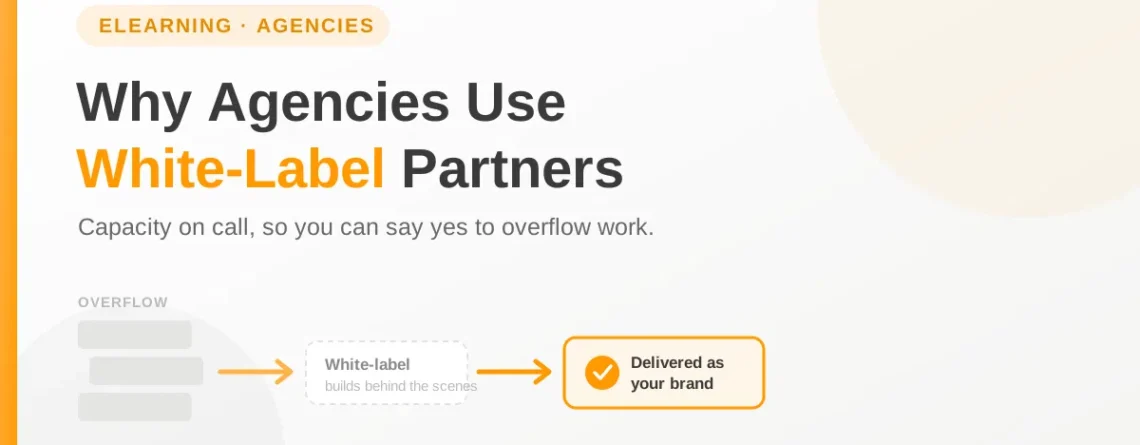
The partner stays behind the scenes. The client sees the agency, the agency’s brand, and the agency’s relationship. The partner simply provides the production muscle, built to the agency’s standards and specifications, ready to hand over as if the agency made it in-house.
That is the whole idea. The agency keeps the client and the credit. The partner provides the capacity. Done well, the client never needs to know, and the quality never tells on itself.
The Overflow Problem Every Agency Knows
Here is the reason this exists at all. Agency work is lumpy, and it is almost impossible to staff perfectly for.
Demand arrives in waves. Several clients approve at once, a big contract lands, a busy season hits. If you staff up for those peaks, you carry expensive people through the quiet months when there is not enough work to keep them busy. If you staff for the average, the peaks crush you.
This is the trap. Match your capacity to your busiest moments and you waste money in the slow times. Match it to normal and you cannot handle the surges. Neither choice works, and every agency owner feels the squeeze of it.
A white-label partner breaks the trap. It gives you capacity exactly when you need it, and none of it when you do not.
Why Agencies Choose This Over Hiring
When overflow hits, hiring looks like the obvious answer. In practice, it often is not. Here is why agencies reach for a white-label partner instead.
- Speed. A new hire takes months to find, onboard, and bring up to speed. A good partner can start almost immediately, which matters when the deadline that created the overflow will not move.
- Flexibility. Overflow is temporary by definition. A partner lets you scale up for the surge and back down when it passes, with no permanent cost left behind.
- No fixed overhead. A hire means salary, benefits, software, and hardware, in good months and lean ones alike. A partner is a cost you take on only when there is revenue to cover it.
- Proven skill, ready to go. An established partner has built many courses and solved most problems before. You get experienced production without the risk and ramp-up of an unproven new hire.
- It protects the client relationship. Instead of turning a good client away because you are full, you deliver on time and keep the relationship strong. The overflow becomes revenue instead of a missed opportunity.
Added up, a partner lets an agency say yes more often, which is the whole point of being in business.
Does It Mean the Agency Is Cutting Corners?
This is the worry that keeps some agencies from trying it, so let me address it head on. Using a white-label partner is not cutting corners. It is smart capacity management, and plenty of respected agencies do it.
Think about how other industries work. A building contractor brings in specialists for parts of a job. A law firm uses outside counsel for overflow. Nobody considers this dishonest. It is simply how capable businesses handle fluctuating demand without compromising what they deliver.
What matters is the quality of the final work, not how many hands touched it. When a partner builds to the agency’s standards and the agency stands behind the result, the client gets exactly what they paid for. The arrangement serves the client well, because the alternative was often a rushed, overloaded, lower-quality job.
What Makes the Partnership Actually Work
Not every white-label arrangement succeeds, so it is worth knowing what separates the good ones. A few things matter most.
Clear standards are everything. The partner needs to know exactly what the agency expects, from design conventions to technical requirements, so the work slots in seamlessly. Reliability matters just as much. The whole value of overflow help evaporates if the partner misses the deadline that made you call them. And discretion is essential. A true white-label partner is comfortable staying invisible, letting the agency own the relationship and the credit entirely.
When those pieces are in place, the partnership feels less like outsourcing and more like having capacity on call. That is exactly what an agency needs when the pipeline surges.
The Quiet Advantage
The agencies that handle growth most gracefully are rarely the ones with the biggest permanent payroll. They are the ones who have figured out how to flex. They say yes to the big project, deliver on time, and keep every client happy, because they are not limited to only what they can build alone this week.
A white-label partner is how many of them do it. It is not a sign of weakness or a shortcut. It is a quiet competitive advantage, letting an agency stay lean, flexible, and ready for whatever the pipeline throws at it.
So if you run an agency and overflow has you choosing between turning away good work and risking your quality, know that there is a third option. The best in the business have been using it all along.
If you are an agency looking for a reliable white-label partner to handle overflow without compromising quality, that is exactly the kind of work I do. Reach out anytime about your next custom eLearning project.