Let me describe a scene you have probably lived. A training dashboard glowing green. Ninety-eight percent complete. Everyone finished, every certificate issued. The report goes up the chain, and for a moment it feels like a win.
Then a few weeks later, the same mistakes keep happening on the floor. The behavior the training was meant to change has not budged. And you are left wondering how something that looked so successful on paper did so little in real life.
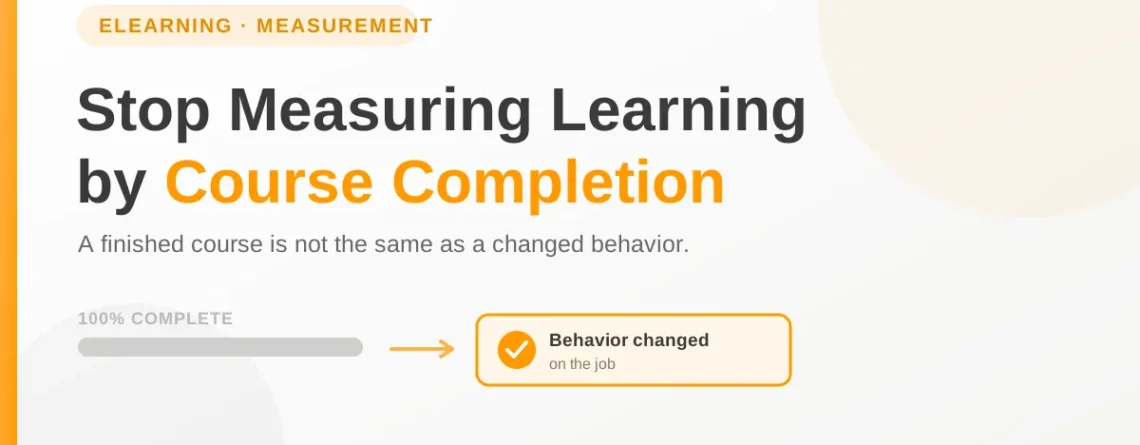
Here is the uncomfortable answer. We measured the wrong thing. We measured completion, when completion was never the point. Let me explain why this metric fools us, and what to track instead.
Completion Measures Attendance, Not Learning
Think about what a completion record actually tells you. It says a person opened the course, clicked through to the end, and maybe passed a quiz. That is it.
It does not tell you whether they understood anything. It does not tell you whether they can apply it. It does not tell you whether a single thing about their work will change tomorrow. A completion is a record of presence, not proof of learning.
We treat it as more than that because it is easy. Completion is simple to track, simple to report, and simple to defend. But easy to measure is not the same as worth measuring. We have built an entire habit around a number that was only ever telling us who showed up.
Why the Green Dashboard Is So Tempting
I understand the pull. When you are managing training at scale, a clean completion report feels like safety. It is something concrete to show leadership. It proves the program ran.
And in a compliance context, there is a real reason to track it. Sometimes you genuinely need a record that training happened, for legal or audit purposes. I am not saying completion is useless. I am saying it is not a measure of learning, and we get into trouble when we confuse the two.
The danger is that the green dashboard lets everyone stop asking the harder question. It looks like proof of success, so nobody digs deeper. The risk gets hidden behind a number that was never designed to catch it.
What We Should Be Measuring Instead
If completion is the floor, here is what actually tells you whether learning happened. These are the signals worth your attention.
- Behavior change on the job. The real test is what people do differently after the course. Are the mistakes dropping? Is the new process being followed? This is harder to track, and it is the only thing that truly counts.
- Application, not recall. A quiz can show someone remembers a fact for ten minutes. A better check asks them to use the knowledge in a realistic situation, because using it is what the job requires.
- Confidence and capability. Ask learners whether they feel ready to do the thing you taught. Self-reported confidence is not perfect, but paired with a real task, it tells you far more than a completion checkmark.
- Performance outcomes. Look at the numbers the business already cares about. Fewer safety incidents, faster onboarding, lower error rates. When training works, it shows up here, even if slowly.
- Retention over time. Learning that vanishes in a week was not really learning. Checking back a month later reveals whether anything actually stuck.
Notice that every one of these is about change, not about finishing. That shift in focus changes everything about how you design and judge a course.
This Changes How We Design, Too
Here is something I have found. The moment you stop designing for completion and start designing for change, your courses get better on their own.
When completion is the goal, you build to be finished. You cover the material, add a quiz, and call it done. When behavior change is the goal, you build to be used. You add realistic practice, you focus on the decisions people actually face, you cut the filler that does not serve the outcome.
The metric you chase quietly shapes everything you make. Chase the wrong one, and you optimize for click-through speed. Chase the right one, and you optimize for real understanding. Same effort, completely different course.
How to Start Shifting the Measure
You do not have to overhaul your whole evaluation system overnight. Small steps move you in the right direction.
Start by adding one real-application check to a course, a scenario or task that proves the learner can use what they learned. Then, a few weeks after a training rolls out, ask one simple question of managers or learners: is anything actually different? Even that informal feedback tells you more than the completion report ever did.
Over time, connect your training to a business metric that already exists. You do not need a perfect measurement model. You need to start looking past the green dashboard and asking whether the work worked.
The Real Finish Line
Course completion feels like the finish line because it is where the course ends. But the course ending and the learning succeeding are two completely different events, and we have spent years treating them as one.
The real finish line is out on the job, days or weeks later, when a person does something better because of what they learned. That is the moment our work is actually for. A completion certificate cannot see that moment. We have to look for it ourselves.
So the next time a dashboard turns green, enjoy it for a second, then ask the better question. Not did they finish, but did it change anything. That question is where real learning begins to be measured.
If you would like help building training that proves its worth through real change and not just completion numbers, that is exactly the kind of work I do. Reach out anytime about your next custom eLearning project.