Choosing someone to build your courses is a little like hiring a contractor to renovate your home. The portfolio looks great, the pitch sounds confident, and you sign the contract hopeful. Then the real work begins, and you find out whether you picked well.
I have been on the development side of that relationship for a long time, and I have also watched clients get burned by the wrong choice. The pattern is almost always the same. The early conversations focused on the obvious things, and the things that actually mattered only showed up once it was too late.
So let me save you some of that pain. If you are looking for a partner to build in Articulate Storyline or Rise, here is what truly deserves your attention before you commit.
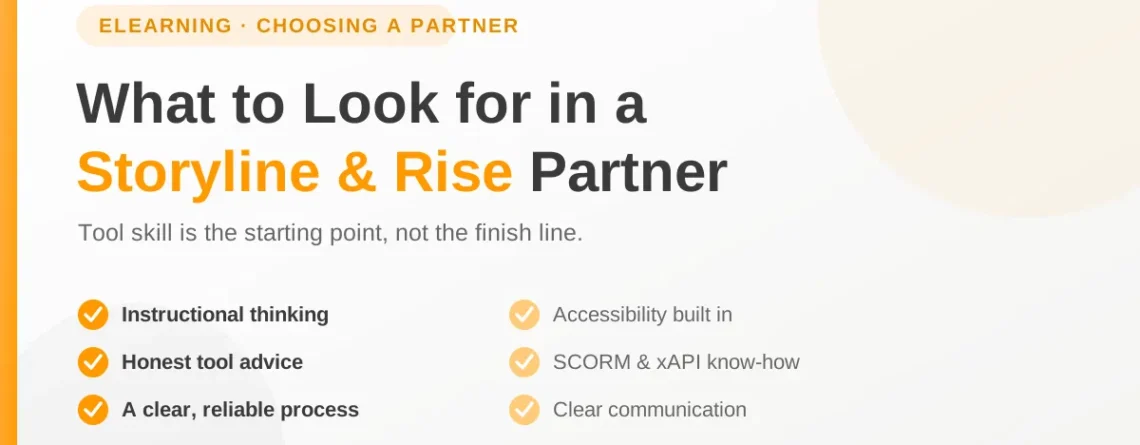
Tool Skill Is the Starting Point, Not the Finish Line
Yes, your partner needs to know the tools. Storyline and Rise each have their own strengths, quirks, and limits, and a skilled developer knows which tool fits which job.
But here is the trap. Tool skill is the easiest thing to claim and the easiest thing to assume is enough. Plenty of people can build a slide in Storyline. Far fewer can design a course that actually teaches. The software is just the instrument. What you really need is someone who understands the music.
So when you review a portfolio, look past the animations and interactions. Ask yourself whether the course was built to teach something, or just built to look busy. That difference tells you far more than any list of tool proficiencies.
Look for Instructional Thinking, Not Just Pretty Slides
This is the quality that separates a true partner from a button-pusher. Does this person think about learning, or only about production?
A developer who thinks instructionally asks different questions. Who is the learner? What do they need to be able to do afterward? Where will they get confused? Those questions shape everything, and they are the reason one course changes behavior while another just fills time.
When you talk to a potential partner, notice what they ask you. If every question is about colors, logos, and slide counts, be cautious. If they ask about your learners and your goals, you have found someone who understands that the design matters more than the decoration.
Storyline and Rise Are Different Tools for Different Jobs
A good partner will not push you toward one tool for every project. They will help you pick the right one for the job in front of you.
Rise is fast, clean, and responsive. It shines for content that is mostly linear, needs to work beautifully on phones, and has to be produced quickly. Storyline is the powerhouse. It gives you custom interactions, branching scenarios, and precise control, which makes it the right choice when the learning calls for real practice and decision making.
The mistake I see is forcing every project into whichever tool someone happens to prefer. A partner worth hiring knows both well enough to recommend honestly, even when the honest answer is the simpler, cheaper tool. That willingness to steer you right, rather than up, is a sign of the kind of integrity you want.
The Practical Signs of a Reliable Partner
Beyond skill and thinking, there are everyday qualities that make a project smooth instead of stressful. Here is what I would check for.
- Clear communication. You want someone who explains things in plain language, responds promptly, and tells you the truth about timelines. How they communicate during the sales conversation is a preview of the whole project.
- A real process. Ask how they work. A dependable partner has a clear path from kickoff to delivery, with review points along the way. A vague process usually means surprises later.
- Respect for review and feedback. Good development is collaborative. Your partner should welcome your subject matter expert’s input and build in checkpoints, rather than disappearing and returning with a finished product nobody got to shape.
- Accessibility know-how. If your learners include people with disabilities, and they almost always do, your partner should understand accessibility standards and build with them in mind, not bolt them on at the end.
- Standards that just work. Your courses need to run properly on your platform. A partner who knows SCORM, xAPI, and LMS behavior saves you from the all too common nightmare of a course that looks fine but will not track or launch.
None of these are flashy. All of them are the difference between a project you enjoy and one you endure.
Ask About the Hard Parts
Here is a tip that will tell you a lot very quickly. Ask a potential partner about the parts that usually go wrong.
What happens when the content changes midway? How do they handle revisions? What if the subject matter expert is slow, or the source material is a mess? A seasoned partner has calm, specific answers, because they have lived through all of it. Someone who waves these away or promises everything will be perfect has either not done enough projects or is not being straight with you.
The goal is not to scare them. It is to see how they think when things get difficult, because on a real project, something always does.
The Real Question Underneath
When you strip it all away, you are not really hiring someone to operate software. You are hiring someone to turn your content into learning that works, and to make the journey there a good one.
So look for the person who cares about your learners as much as you do. Who is honest about tools, generous with their thinking, and steady when things get complicated. The tool skills matter, but they are table stakes. The judgment, the communication, and the care are what you are actually paying for.
Choose on those, and the finished courses tend to take care of themselves.
If you are looking for a Storyline and Rise partner who thinks about learning first and builds to match, that is exactly the kind of work I do. Reach out anytime about your next custom eLearning project.