For a long time, a lot of training decisions came down to a gut feeling. Which course to build next, what was working, where learners were struggling. We made our best guesses, shipped the course, and hoped.
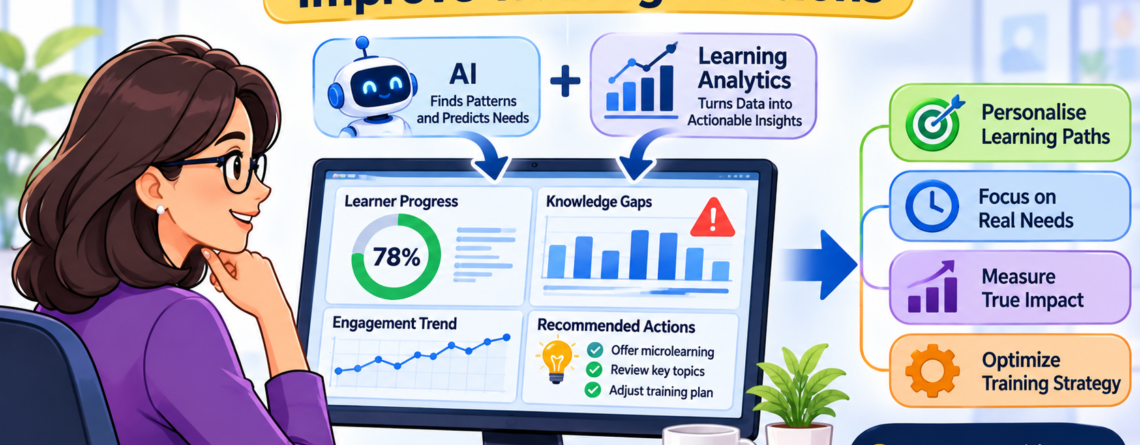
That is changing, and it is one of the more exciting shifts in our field. Between learning analytics and AI, we now have the ability to replace a lot of that guessing with actual evidence. We can see what learners do, spot patterns we would have missed, and make decisions grounded in what is really happening instead of what we assume is happening.
I want to be measured about this, because the technology is easy to oversell. But used well, data and AI genuinely help you make better training decisions. Let me walk through how.
From Guessing to Seeing
Start with the simplest benefit. Learning analytics lets you see what was invisible before.
In the past, once a course went live, it mostly disappeared into a black box. You knew who finished, and little else. Now you can see far more. Where learners spend their time, where they slow down, which questions they get wrong, where they drop off, and what they go back and review.
That visibility changes the nature of the decision. Instead of guessing where a course is weak, you can look. Instead of assuming learners understood a section, you can check whether they actually did. It is the difference between designing in the dark and designing with the lights on.
Where AI Adds Real Value
Analytics gives you the data. The challenge is that there is often a lot of it, and raw numbers do not explain themselves. This is where AI earns its place. Here is what it genuinely helps with.
- Spotting patterns you would miss. Across hundreds of learners and thousands of interactions, AI can surface patterns a human would never catch by eye, like a specific point where a certain group consistently struggles.
- Making sense of the noise. AI can help turn a mountain of raw data into a readable summary, pointing you toward what deserves attention instead of leaving you to sift through everything yourself.
- Flagging the early signals. AI can notice when something is trending in the wrong direction, a rising drop-off or a dipping score, often before it would become obvious to you.
- Suggesting where to look. Based on the patterns, AI can point you toward the sections or groups most worth your attention, so your limited time goes where it matters most.
Notice the theme. AI is not making the decision. It is helping you see more clearly and faster, so the decision you make is better informed. That distinction matters, and I will come back to it.
Better Decisions, Not Just More Data
Here is a trap worth naming. Data for its own sake is not helpful. A dashboard full of numbers that never changes a decision is just noise with a nice interface.
The point of all this is better decisions, so it helps to be concrete about what those look like. The data might tell you which course to revise first, because it shows you exactly where learners are struggling most. It might tell you a section needs to be reworked, because everyone slows down and scores poorly right there. It might tell you a course is too long, because drop-off climbs steadily toward the end.
Each of these is a real decision made better by evidence. The value is not in having the data. It is in letting the data change what you do. If the numbers never alter a choice, you do not have analytics. You have decoration.
Keep Human Judgment in the Driver’s Seat
As powerful as this is, I want to be clear about something. Data and AI inform decisions. They should not make them for you.
The numbers tell you what is happening, but not always why, and the why is where human judgment is essential. Data might show learners dropping off at a certain point. It cannot tell you whether the content is confusing, the topic is boring, or something outside the course is pulling them away. You still have to interpret, and that interpretation draws on an understanding of people that data alone does not have.
AI is the same. It can surface a pattern and even suggest a cause, but it does not truly understand your learners, your context, or your goals. So treat its output as a well-informed opinion to weigh, not an instruction to follow. The tools make you a sharper decision maker. They do not replace the deciding.
Start Small and Build the Habit
If this sounds like a big undertaking, it does not have to be. You do not need a sophisticated system to start making better decisions with data.
Begin by actually looking at the data you already have. Most platforms already track more than people use. Pick one course and genuinely study its numbers. Where do people drop off? What do they get wrong? Let that one investigation change one decision, and you have already started.
From there, it becomes a habit. Each course teaches you something that improves the next. Over time, you shift from designing on instinct alone to designing on instinct sharpened by evidence, which is a powerful combination. The instinct still matters. It is just no longer flying blind.
The Bottom Line
The old way of making training decisions leaned heavily on guesswork, and we did the best we could with it. We do not have to work that way anymore. Learning analytics lets us see what learners actually do, and AI helps us make sense of what we see.
Used well, these tools move us from hoping a course works to knowing where it does and does not, and acting on that knowledge. The goal is not data for its own sake, and it is certainly not handing decisions to a machine. It is making better choices, grounded in evidence, with human judgment firmly in charge.
If you want help using analytics and AI to make smarter decisions about your training, that is exactly the kind of work I do. Reach out anytime about your next custom eLearning project.