Corporate training has a particular set of pressures. Lots of content, frequent updates, tight budgets, and compliance teams who need things done a certain way. So when it comes to narration, the choice between an AI voice and a human one is not just an artistic preference. It is a practical business decision with real tradeoffs.
I have used both across corporate projects, and I have learned that the right answer depends almost entirely on what kind of training it is. A onboarding refresher and a sensitive harassment course are not the same job, and they should not automatically get the same kind of voice. Let me lay out how I decide.
One caveat before I start. AI voice quality is improving quickly, so treat my read on it as current rather than permanent, and judge any tool against your own content.
Why AI Voiceover Fits a Lot of Corporate Training
For a large share of corporate content, AI voiceover is genuinely the sensible choice, and not as a compromise.
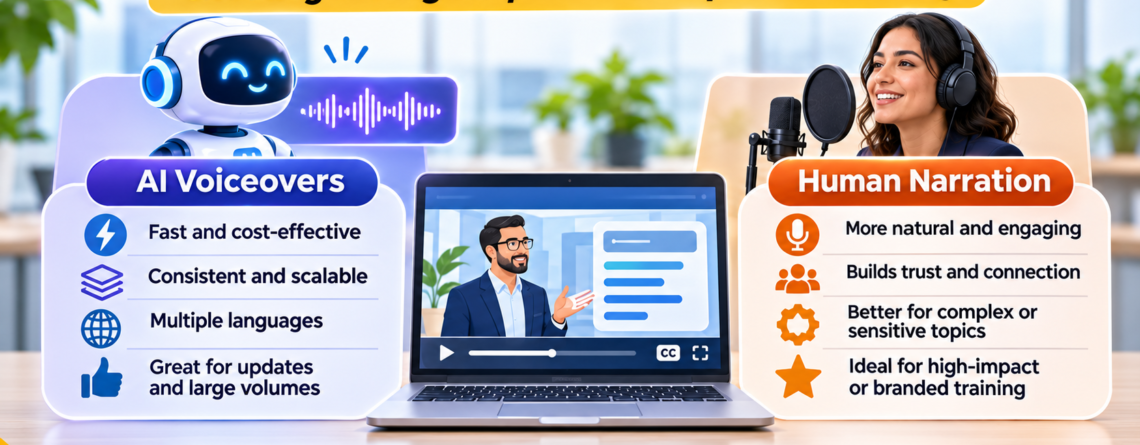
- Content that updates constantly. Policies change, systems change, product details change. Re-recording a human narrator every time is slow and costly. With AI, you regenerate only the lines that changed, in minutes.
- High volume. Corporate libraries are big. When you have hours of clear, factual narration to produce, AI does it quickly and consistently without booking studio time.
- Standardization across a catalog. A consistent voice across dozens of modules is easy to maintain with AI. The tone stays uniform no matter how much content you add.
- Budget reality. Not every internal course can justify professional narration. A strong AI voice is far better than robotic text-to-speech, and far better than no narration at all.
For straightforward informational training, onboarding basics, system walkthroughs, policy overviews, product knowledge, AI voiceover usually wins on the practical math.
Where Corporate Training Still Needs a Human Voice
But corporate training is not all routine information. Some of it carries real weight, and that is where a human voice earns its cost.
- Sensitive subjects. Harassment, ethics, mental health, serious safety consequences. These need a voice that conveys genuine care. Learners sense when warmth is simulated, and in these moments that gap undercuts the trust the training depends on.
- Leadership and culture messages. When training is meant to reflect the organization’s voice and values, a human narrator signals that the company took it seriously. A synthetic voice can quietly send the opposite message.
- Storytelling and scenarios. When a scenario relies on a character feeling real, human timing and emotion do the work that makes it land. A flat AI read can drain the life out of it.
- Flagship programs. The high-visibility course that leadership cares about, or that represents the brand externally, is usually worth the human touch as a matter of quality signaling.
The pattern is consistent. Wherever the delivery itself carries emotional or cultural weight, the human voice is doing something AI cannot yet replicate.
The Questions That Settle It
When I am deciding for a specific corporate course, a few questions usually make the answer clear:
- What is the emotional weight? The heavier and more sensitive the subject, the more a human voice is worth it.
- How often will it change? Frequent updates push strongly toward AI’s flexibility.
- Is this routine or representative? Routine information is fine for AI. Content that represents the company’s voice or values leans human.
- What does the budget genuinely allow? A good AI voice on a real budget beats an imagined human recording that never gets made.
These questions matter more than any blanket policy, because corporate catalogs contain both kinds of content at once.
You Can Use Both in One Program
Here is a point worth stressing for corporate work specifically. You are rarely choosing one voice for everything. A training program usually contains a mix, and you can match the voice to each part.
Use AI voiceover for the high-volume, frequently-updated, informational modules where speed and consistency matter. Reserve human narration for the sensitive courses and the flagship, culture-defining content where it counts. This is often the smartest approach for a corporate client, because it controls cost across the bulk of the catalog while protecting quality exactly where the stakes are highest.
Thinking at the level of the whole program, rather than making one decision for everything, usually gives the best result for the budget.
Match the Voice to the Stakes
So here is where I land for corporate training specifically. AI voiceover is a genuinely good fit for the large, routine, frequently-changing core of most corporate catalogs. Human narration remains the right call for sensitive subjects, culture and leadership messages, and flagship programs. And for most organizations, the best strategy is to use each where it fits rather than committing to one across the board.
The mistake I see is treating it as a single policy decision. “We use AI for everything” quietly flattens the courses that needed warmth. “We only use human voice” overspends on content that never needed it. The better approach is to look at each course and ask what the stakes are, then choose accordingly.
So the next time you are planning narration for a corporate program, do not pick a voice for the whole catalog. Sort the content by what it needs, and let the stakes of each course decide.
If you want a partner who helps you make that call course by course, using AI where it serves the budget and human narration where it serves the learning, that judgment is exactly what I bring. You can always reach out for help with your next custom eLearning project.