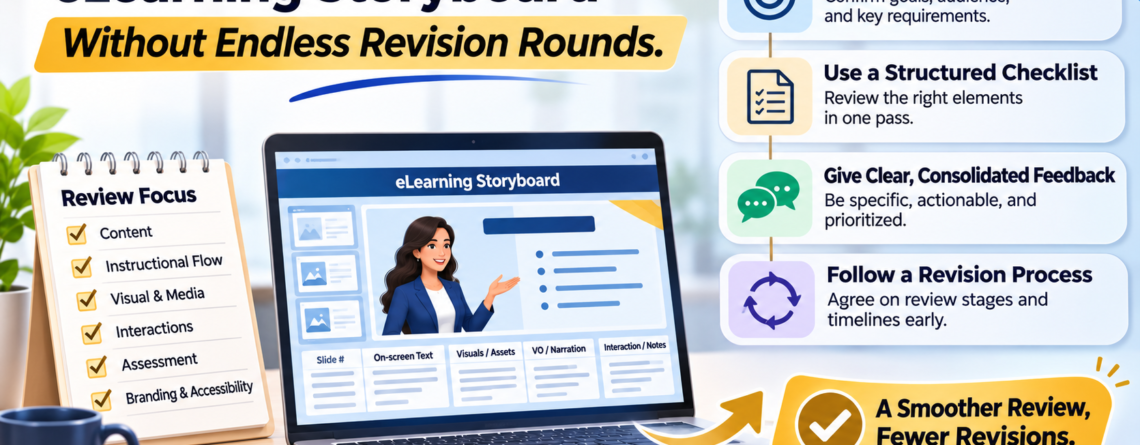
If you have built courses for any length of time, you know the pain of the never-ending storyboard review. A draft goes out. Feedback comes back in scattered pieces. You make changes. New feedback arrives on things that were fine before. A stakeholder who went quiet suddenly reappears with opinions on round four. And somehow a document that should have been approved in two passes drags through six.
The frustrating part is that the storyboard itself is usually fine. The problem is the review process around it. Revision rounds spiral not because the work is bad, but because the review was never set up to end.
Good news: this is fixable. A few changes to how you run the review will cut those rounds down dramatically. Here is what works for me.
Agree on What a Storyboard Review Is For
A lot of revision chaos comes from people reviewing the wrong things at the wrong time. Someone comments on word-for-word phrasing when the structure is not even settled. Someone else questions the whole approach after the detailed content is already written.
Before anyone reviews, set the frame. A storyboard review is about whether the content is correct, complete, and logically sequenced. It is about the learning, not the final polish of every sentence or the exact shade of a button. When reviewers understand that, they stop spending round one on things that belong in round three, and you stop rebuilding work that was never wrong.
It helps to say this out loud at the start: “At this stage I need you to check accuracy and flow. We will handle visual and wording polish later.” That one sentence prevents a surprising amount of churn.
Get the Right People in the Right Round
Endless revisions often come from the wrong review order. The classic disaster is building everything out in detail, getting it approved by your main contact, and then having a senior stakeholder appear at the end to question the fundamental approach. Now you are rebuilding from scratch.
The fix is to sequence reviewers deliberately:
- Settle the big decisions first. Get the people who can challenge the approach, scope, and structure to weigh in early, on an outline or a first section, before the whole thing is built.
- Bring detail reviewers in once the direction is locked. Subject matter experts checking accuracy should review after the structure is agreed, not alongside the person questioning whether the structure should exist.
- Know who actually approves. Be clear about whose sign-off ends the review. Feedback from people who are not the decision-maker is useful input, not a reason to reopen settled work.
When the approach is locked before the details are polished, you avoid the single most expensive kind of rework.
Consolidate Feedback Into One Source
Nothing multiplies revision rounds like scattered feedback. Comments in an email, a few more in a chat message, some verbal notes from a call, and contradictory edits from two reviewers who never saw each other’s comments. You end up playing messenger and mediator instead of designer.
Insist on one channel and one consolidated version. All feedback goes in the same document, where everyone can see it. When two reviewers disagree, that conflict surfaces in one place and gets resolved before it reaches you, instead of landing on your desk as two incompatible change requests you are somehow supposed to reconcile.
This one change, gathering feedback in a single shared place, quietly removes a whole category of extra rounds.
Ask for Specific, Actionable Feedback
“This doesn’t feel right” is not feedback you can act on. Vague reactions lead to guesswork, and guesswork leads to another round where you find out you guessed wrong.
When you set up the review, ask for the kind of feedback you can actually use:
- Point to the specific place. Which slide, which line, which element. Not a general impression of the whole thing.
- Say what is wrong, not just that something is. “This step is out of order” beats “this section is confusing.”
- Suggest a direction where possible. Reviewers do not have to write the fix, but “I think learners need an example here” is far more useful than “needs work.”
You will not always get perfect feedback, but asking for it shifts the quality upward, and specific feedback can be resolved in one pass instead of three.
Set the Number of Rounds Up Front
Here is a simple move that changes behavior: tell everyone at the start how many review rounds there are. Something like two rounds of consolidated feedback, then sign-off.
When reviews feel infinite, people treat them that way. They hold back, they revisit settled points, they leave the real thinking for “next time.” When everyone knows there are two rounds, they bring their serious feedback now, because they can see the window closing. A defined endpoint is one of the most effective tools you have for getting complete feedback early instead of in a slow trickle.
This is not about being rigid. If something important genuinely surfaces late, you handle it. But setting the expectation of a limited, defined process changes how seriously people treat each round.
Design the Process, Not Just the Course
The thread running through all of this is simple. Endless revision rounds are almost never a content problem. They are a process problem. The storyboard was fine. The review was just set up to sprawl.
So treat the review as something you design, the same way you design the course. Decide what each round is for, who is in it, where feedback goes, what good feedback looks like, and when it ends. Spend ten minutes setting that up at the start, and you save yourself days of circular revisions at the end.
Your storyboard deserves a review process that ends. Most of the time, you are the one who gets to design it.
If you want a partner whose process is built to keep reviews tight and projects moving, instead of spiraling into endless rounds, that is exactly how I like to work. You can always reach out for help with your next custom eLearning project.