Video has always been one of the more expensive parts of an eLearning project. Traditional animation especially, with its storyboards, asset creation, and careful frame-by-frame work, takes time and money. So when AI eLearning Videos vs. Traditional video generation arrived promising to produce finished-looking clips from a prompt in minutes, a lot of people understandably asked the obvious question. Why not just use that instead?
It is a fair question, and the answer is more interesting than a simple winner. Having worked with both, I have come to see them less as rivals and more as different tools for different jobs. Let me lay out where each one actually wins, so you can choose based on the project in front of you rather than the hype.
Before I do, a quick caveat. AI video is moving fast, and what it can and cannot do is a moving target. Treat this as my current read, and test any tool against your own needs before committing.
Where AI-Generated Video Wins
The appeal of AI video is real, and for the right project it is genuinely the better choice.
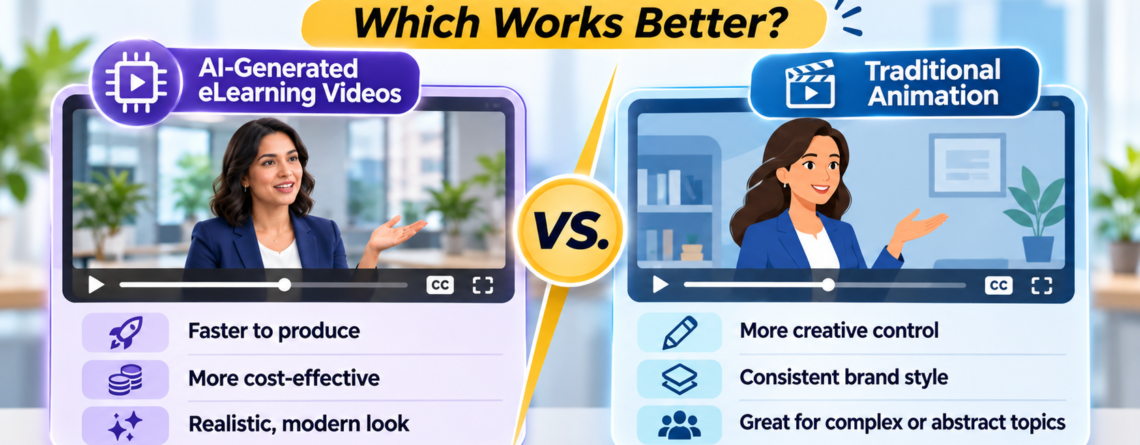
- Speed and cost. This is the headline. AI can produce usable video far faster and cheaper than traditional animation. For tight budgets and timelines, that can be the difference between having video and having none.
- Volume. When you need a lot of short clips, AI scales in a way hand-built animation simply cannot on a normal budget.
- Content that changes often. If a video will need updating every few months, regenerating is far easier than re-animating from scratch.
- Rapid concepting. Even if you end up building the final piece traditionally, AI is useful for quickly visualizing an idea before you commit resources to it.
For straightforward, informational, or fast-turnaround video, AI often is the sensible answer. The economics are hard to argue with.
Where Traditional Animation Still Wins
Now the other side, because there are things careful, built-by-hand animation does that AI still struggles to match.
- Precise control. When every element has to be exactly where you want it, matching a brand, hitting an exact action on an exact word of narration, traditional animation gives you that control. AI gives you an approximation of your prompt, which is not the same thing.
- Consistency across a series. Keeping a character or style identical across many scenes and multiple videos is still a real weakness for AI, which tends to drift. Hand-built animation holds its look reliably.
- Clarity for complex concepts. When the whole point of the video is to explain a specific process or mechanism step by step, the deliberate control of traditional animation often communicates more clearly than AI’s more general output.
- Polish and brand trust. For a flagship or brand-defining piece, the precision and intentionality of crafted animation signals quality in a way that matters when the stakes are high.
The theme here is control and consistency. Wherever the video has to be exactly a certain way, and stay that way across scenes, traditional animation still earns its cost.
The Quality Questions That Actually Decide It
Beyond speed and control, there are a few practical quality issues worth checking before you lean on AI video, because they are where generated clips most often fall short:
- Does it stay consistent? Watch for characters or styles that shift between scenes. Inconsistency breaks the illusion fast.
- Does it look right? Check for the small physical glitches AI still produces, odd anatomy, wrong scale against the environment, awkward movement. These details quietly undermine a professional feel.
- Does it actually clarify, or just decorate? A video that looks dynamic but does not make the concept clearer is not doing its job, no matter how it was made.
Traditional animation does not get a free pass on these either, but it gives you the control to fix them deliberately. With AI, you are often regenerating and hoping, which has its own time cost that can eat into the speed advantage.
It Is Not Always Either-Or
Here is the part I find most useful in practice. You do not have to pick one approach for an entire project. Some of the best results come from combining them.
You might use AI video for the high-volume, informational segments where speed matters and precision is less critical, and reserve traditional animation for the key explainer or the brand-defining moment that has to be exactly right. The learner gets efficient production where efficiency is fine, and crafted quality where it counts. Thinking segment by segment usually beats a blanket decision either way.
So, Which Works Better?
The honest answer is that neither is better in the abstract. The right choice depends on what the specific video needs to do.
If you need speed, volume, low cost, or content that updates often, AI-generated video is frequently the smart call. If you need precise control, consistency across a series, clarity for a complex concept, or flagship-level polish, traditional animation still wins. And for many projects, the best move is to use each where it is strongest rather than forcing one to do everything.
The mistake is treating this as a loyalty test, where you are either pro-AI or pro-traditional. The professionals getting the best results are not loyal to a method. They are loyal to the outcome, and they pick the tool that gets there for each piece of the project.
So the next time you plan video for a course, do not ask which method is better. Ask what this particular video needs to accomplish, and let that decide.
If you want a partner who knows when AI video is the smart choice and when only crafted animation will do, that judgment is exactly what I bring. You can always reach out for help with your next custom eLearning project.