There is a quiet worry running through our profession right now. If AI Is Changing the Role of Instructional Designers scan write scripts, draft assessments, generate images, and produce voiceover, what is left for the instructional designer to do? Are we slowly automating ourselves out of a job?
I understand the worry, but I do not share it. What I see happening is not the disappearance of the role. It is a shift in what the role is made of. The parts of the job that were always the least valuable are being handed to AI, and the parts that were always the real work are becoming more central. The job is not shrinking. It is changing shape.
Let me walk through how, because I think the change is mostly good news for anyone willing to move with it.
A quick note first: the field is moving quickly, so take this as my current read rather than a settled forecast. But the direction has been clear enough for a while that I am fairly confident in the shape of it.
What AI Is Taking Off Our Plates
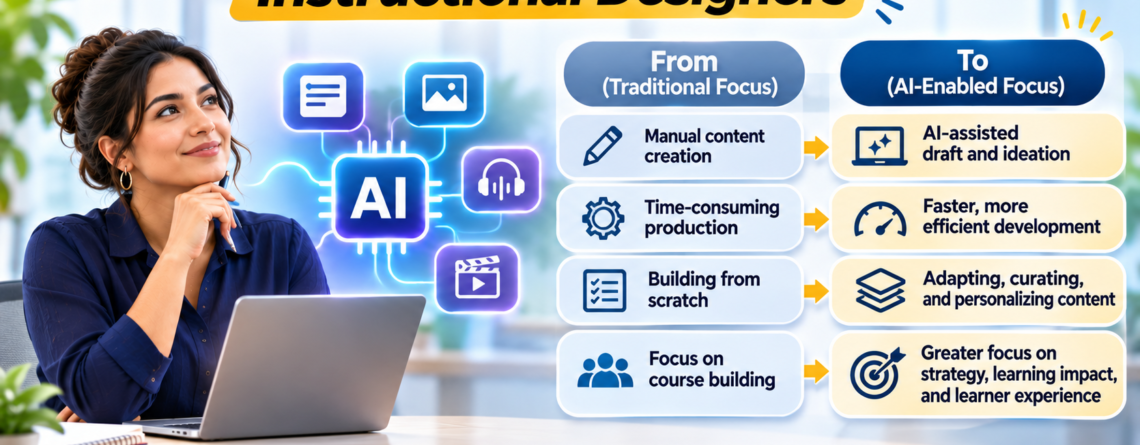
Start with what is actually changing in the day-to-day. A lot of the production work that used to eat our hours is now something AI can draft.
- First-draft writing. Scripts, on-screen text, and summaries that once took hours now start from a draft we refine.
- Assessment drafts. Generating question options to then sharpen, instead of writing each from a blank page.
- Media production. Draft visuals and synthetic voiceover for suitable content, produced quickly.
- Repetitive formatting and rework. The tedious middle of a build, where we reword, reshape, and reformat, is exactly what AI handles well.
Notice that none of these were ever the heart of the job. They were the labor around the thinking. For years we spent a large share of our time on production simply because someone had to. AI is now absorbing a lot of that, and honestly, I do not miss it.
What Is Becoming More Important, Not Less
Here is the part that matters. As AI takes over production, the uniquely human parts of the role are not fading. They are moving to the center, where they probably always belonged.
- Analysis and diagnosis. Figuring out what the real problem is, whether training is even the answer, and what success looks like. AI cannot do this. It does not know your organization or your learners.
- Instructional judgment. Deciding what matters, what to cut, how to sequence for a specific audience, and how to design assessment that measures real capability. This is the craft, and it is still entirely ours.
- Stakeholder work. Managing clients and experts, asking the right questions, navigating competing priorities, and translating vague requests into clear goals. This is deeply human work.
- Quality and judgment calls. Knowing when the AI output is wrong, generic, or missing the point, and having the taste to fix it. AI makes this more important, not less, because someone has to catch what it gets wrong.
When production stops consuming most of our time, these are what fill the space. The designer becomes less of a producer and more of a thinker, editor, and decision-maker. That is a more valuable role, not a smaller one.
From Maker to Director
If I had to capture the shift in a phrase, it is a move from maker to director. We used to make most things by hand. Increasingly, we direct the making.
A director does not personally operate every camera, but nothing good happens without their judgment about what the scene needs. That is close to where the instructional designer is heading. We guide the AI, decide what is worth keeping, shape the raw material into something coherent, and take responsibility for whether the final thing actually works. The hands-on production matters less. The judgment matters more.
This is not a lesser job. Directing well is harder than producing on autopilot, because it demands you know exactly what good looks like and why.
The New Skills Worth Building
If the role is shifting, the skills worth investing in are shifting too. From what I can see, the designers who will thrive are strengthening a few things:
- Deeper design fundamentals. The better your grasp of how people actually learn, the more valuable your judgment becomes, precisely because AI has none of it.
- Editing and evaluation. The skill of looking at generated output and knowing what is weak, generic, or wrong is becoming central. Taste is a competitive advantage.
- Working with AI deliberately. Not fearing it, not blindly trusting it, but learning where it helps and where it hurts, and directing it well.
- The human-facing work. Analysis, stakeholder management, and communication only grow in value, because they are furthest from anything AI can do.
Notice that most of these are not technical tricks. They are judgment, taste, and people skills. The shift rewards the parts of the profession that were always about thinking, not tooling.
The Role Is Changing, Not Ending
So here is where I land. AI is not making instructional designers obsolete. It is dissolving the production-heavy version of the job and replacing it with a judgment-heavy one. For people who got into this field because they love the craft of designing learning, that should be encouraging. The craft is exactly the part that is becoming more important.
The designers at risk are not the ones who use AI. They are the ones who defined their value entirely by production that AI can now do, and who refuse to move up into the thinking. The work is still here. It just asks more of our judgment and less of our hands.
If you want a partner who treats AI as a tool to sharpen the craft rather than replace it, and who brings real instructional judgment to the work, that is exactly how I approach every project. You can always reach out for help with your next custom eLearning project.