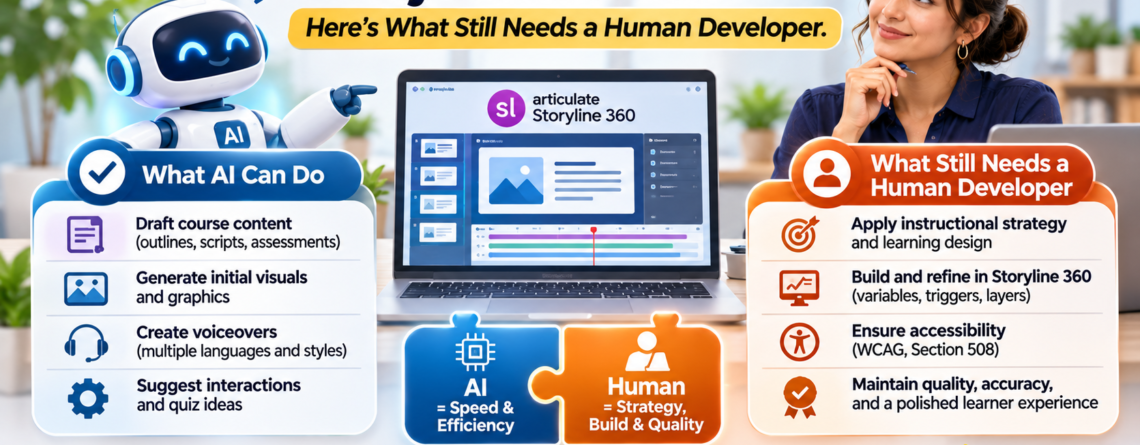
It is a fair question to ask in 2026, and I get asked it often. AI can write, generate images, produce voiceover, and draft assessments. So can it just build the whole Storyline course for me, start to finish, and hand back a finished file?
The honest answer is no, not yet, and not in the way people hope. AI can do a surprising amount of the pieces. What it cannot do is be the developer who turns those pieces into a course that actually works inside Storyline. Let me walk through where the line falls, because understanding it helps you use AI well instead of expecting something it cannot deliver.
I should say up front that tools are moving quickly, so treat this as my current read rather than a permanent verdict. But the gaps I am describing are about judgment and craft, and those tend to move slower than the hype.
What AI Can Genuinely Contribute
Let me give AI real credit, because it can take meaningful work off your plate before you ever open Storyline.
- The content layer. AI can draft your script, tighten your on-screen text, and turn raw source material into learner-friendly language. This is real help on the writing.
- Assessment drafts. It can generate a batch of question options for you to refine. You still decide what to keep, but you are editing instead of inventing.
- Media starting points. Draft images, placeholder visuals, and synthetic voiceover for the right kind of content are all within reach.
- Structural suggestions. It can propose an outline or a flow that gives you something to react to.
If you add all of that up, it is a genuine head start. By the time you open Storyline, a lot of the raw material can already be drafted. That is not nothing.
Where the Human Developer Is Still Essential
Here is the part people underestimate. Having the raw material is not the same as having a course. The actual development, the work of turning content into a functioning Storyline course, is still human work. A few places where that becomes obvious:
- Building interactions that behave. Triggers, variables, states, and layers are the machinery of a real Storyline course. Setting them up so they work reliably, in the right order, without breaking, is development, and it takes someone who understands the tool deeply.
- Instructional judgment inside the build. Deciding what becomes a click-to-reveal versus a scenario, where a knowledge check belongs, what to cut, and how a specific audience will move through it. AI does not know your learners. The developer does.
- Making it work on every screen and in the LMS. Responsive behavior, SCORM or xAPI setup, tracking that actually reports correctly, and testing across devices. This is the unglamorous work that decides whether a course functions in the real world, and it is squarely human.
- Accessibility done properly. Focus order, keyboard navigation, meaningful alt text, and testing with a screen reader. These require deliberate, hands-on work in the file, not a generated draft.
- Quality control. Catching the broken trigger, the misaligned text, the audio that is a half-second off, the layer that does not reset. The final polish that separates professional work from an approximation is all judgment and attention.
None of these are content tasks. They are development and design tasks, and they are exactly where a generated draft runs out of road.
The Gap Between “Looks Like a Course” and “Is a Course”
This is the distinction at the heart of the question. AI is very good at producing things that look finished. It can hand you something that resembles a course. But resembling a course and functioning as one are different things.
A real Storyline course has to do more than display content. It has to respond correctly to what the learner does, track properly in the LMS, work for someone using a keyboard or a phone, and hold together without a single broken interaction. That reliability is invisible when it is right and glaring when it is wrong, and it comes from a developer who built it carefully and tested it thoroughly. AI can draft the surface. It cannot yet guarantee the machinery underneath.
The Smartest Way to Actually Use AI Here
So the practical answer is not “AI builds the course” and it is not “ignore AI.” It is to let AI do the part it is good at and keep a developer in charge of the part that matters.
In practice that looks like using AI to accelerate the content and the drafts, so the developer spends less time writing and more time building. The human then does what only a human can do right now: make the instructional decisions, build the interactions properly, handle the technical setup, get accessibility right, and quality-check the whole thing. You get the speed of AI on the front end and the reliability of a real developer on the back end.
That combination is genuinely powerful. It is faster than doing everything by hand and far more dependable than hoping a generated file will just work.
The Honest Verdict
Can AI build a complete Storyline 360 course on its own? No. It can build a convincing draft of the content and hand you a strong head start. But the course itself, the working, reliable, accessible, properly-tracking course, still needs a human developer to build it and stand behind it.
I do not think that is a disappointment. I think it is clarity. It tells you exactly where to point AI and exactly where to invest human skill. The teams that understand this are already faster than the ones doing everything manually and more reliable than the ones trusting AI to do it all.
If you want a developer who uses AI to move faster while personally building and testing the course that gets delivered, that is exactly how I work. You can always reach out for help with your next custom eLearning project.