There has been no shortage of hype about AI in our field. Every tool has an AI feature now, every conference has a dozen sessions on it, and every vendor promises it will transform how we build courses. Some of that is real. A lot of it is noise.
I want to cut through some of the noise with a practical take. Setting aside the promises and the demos, where is AI actually earning its place in day-to-day eLearning development? I can only speak from my own work and what I see working for people I trust, so treat this as a practitioner’s view rather than a market report. But from where I sit, a clear pattern has emerged between what delivers and what disappoints.
What’s Genuinely Working
Let me start with the wins, because there are real ones. These are the uses where AI has quietly become part of how good work gets done.
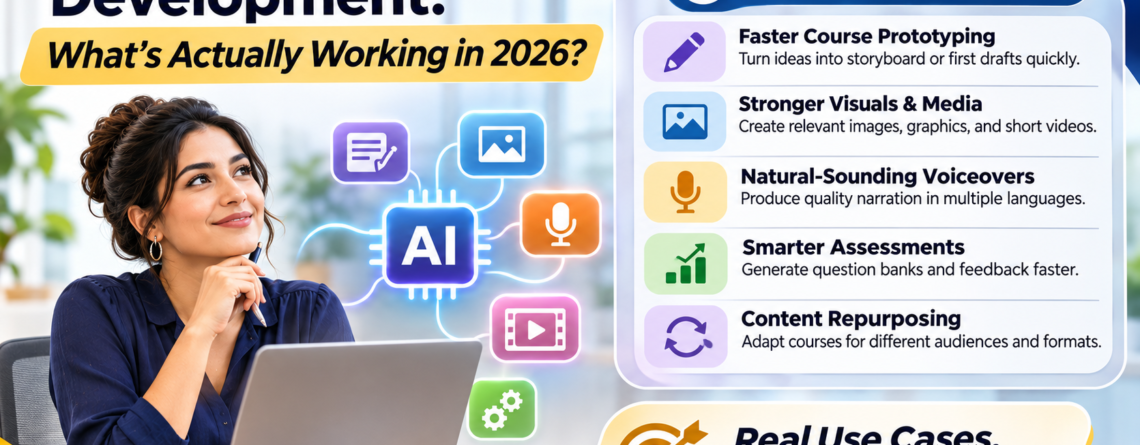
- Beating the blank page. Using AI to generate a first-draft outline, a rough script, or a set of starter questions is now routine, and it is a real time-saver. The output is never final, but reacting to a draft is faster than inventing from zero.
- Rewriting and tightening content. Turning dense source material into cleaner, learner-friendly language is something AI does well. It is a strong editing assistant, especially for a first pass on clunky text.
- Draft assessment questions. Generating a batch of question options to then refine saves real time. You still need a human to make sure they measure the right thing, but starting from a draft set beats writing each from scratch.
- Synthetic voiceover for the right content. For informational narration, placeholder audio, and frequently-updated content, AI voice has become a genuinely practical option, not just a novelty.
- First-draft visuals and placeholders. AI-generated images are useful for mockups, concept exploration, and filling a layout while you decide on final art.
Notice the common thread. In every case, AI is accelerating a draft that a human then shapes. It is a fast first pass, not a finished product. That is where it reliably delivers.
What’s Still Disappointing
Now the other side. These are the areas where the promises run ahead of the reality, at least in my experience.
- “Build a whole course from a prompt.” The demos look impressive. The output, in practice, is generic, shallow, and missing the judgment that makes a course actually work. It can produce something that looks like a course. It cannot yet produce a good one on its own.
- Real instructional judgment. Deciding what matters, what to cut, how to sequence for a specific audience, and how to design a meaningful assessment is still human work. AI does not know your learners or your context, and it shows.
- Accuracy you can trust without checking. AI still states wrong things confidently. For compliance, safety, or technical content, every fact needs a human check. The speed gain disappears if you skip that, because one confident error can be costly.
- Genuine emotional nuance. Whether in voiceover or scenario writing, the moments that need real human warmth and subtlety are still where AI feels thinnest.
The pattern here is the mirror image of the first list. Wherever the task requires judgment, context, or genuine human feeling, AI is still an assistant at best, and a liability if trusted blindly.
The Real Shift Isn’t the Tools
Here is what I think is the most important development, and it is not about any single feature. The real shift in 2026 is not that AI builds courses. It is that AI has quietly absorbed a lot of the busywork, which frees good designers to spend more time on the parts that matter.
When a first draft, a rewrite, or a batch of questions takes minutes instead of hours, that time does not vanish. The best people are pouring it back into deeper analysis, better scenarios, and sharper design. The craft has not been replaced. It has been concentrated. The parts of the job that were always the real value are getting more attention, not less.
That is the quiet story under the hype. The teams getting the most out of AI are not the ones trying to automate the whole job. They are the ones using it to clear the busywork so they can do the thinking.
Where This Leaves Us
So what is the honest state of AI in eLearning development right now? It is a genuinely useful set of tools that has earned a permanent place in the workflow, as long as you are clear-eyed about what it is for.
Use it to accelerate drafts, clear busywork, and get a fast first pass. Do not use it to replace judgment, skip verification, or carry the emotional weight of content that needs a human touch. Keep a person in charge of every decision that actually matters, and let AI handle the parts that were never the point.
The people worried that AI will replace instructional designers are, I think, looking at the wrong risk. AI is not replacing good designers. It is widening the gap between those who use it well and those who either ignore it or lean on it too hard. The skill now is knowing exactly where it helps and where it hurts.
A reminder on all of this: the field is moving quickly, and anything specific I say about tools today may shift by the time you read it. Treat this as a snapshot of what I am seeing work, and test any tool against your own content before you trust it.
If you want a partner who uses AI where it genuinely helps and relies on human judgment where it counts, that is exactly how I work. You can always reach out for help with your next custom eLearning project.