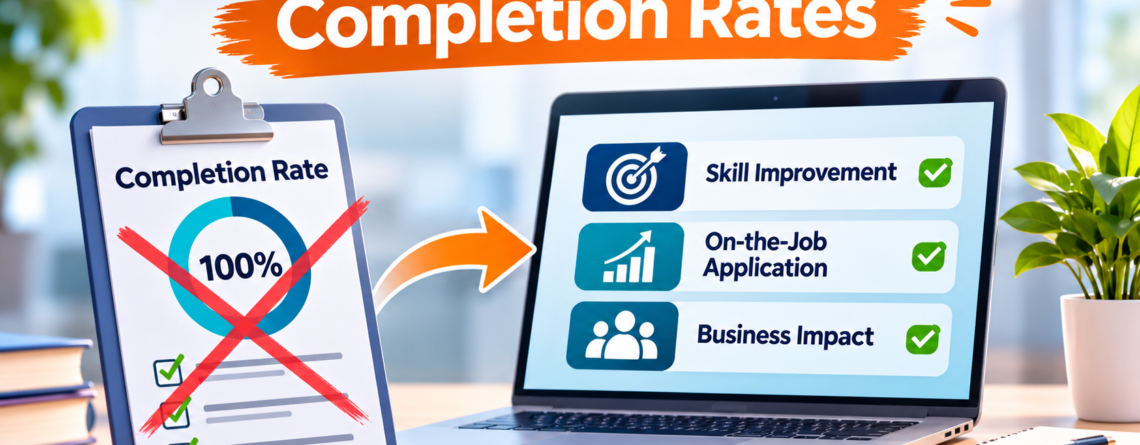
If you have read much about training lately, you have probably heard the message loud and clear. Completion rates do not tell you whether people learned. Fair enough. But that leaves a harder, more useful question hanging in the air.
If not completion, then what? It is easy to say stop measuring completion. It is much more helpful to say what to measure instead, and how to actually do it without a research team or a fancy system.
So let me get practical. Here are the things genuinely worth measuring, and concrete ways to measure each one, even if you are a small operation with limited tools. This is the hands-on companion to the idea that completion is not enough.
Start With the Question, Not the Metric
Before any specific measure, one principle. Always start from what you actually want to know, then find the smallest measure that answers it.
The reason most measurement fails is that people track whatever is easy, then wonder why the numbers do not help. Completion is the classic example. It is easy, so it gets tracked, even though it answers almost nothing useful.
Flip the order. Decide the question first. Did this change behavior? Did people understand the hard part? Where are they getting stuck? Once you know the question, the right measure is usually obvious, and often simpler than you feared.
Measure Application, Not Just Recall
The single most valuable thing to measure is whether learners can actually use what you taught. Here is how to do it without overcomplicating things.
- Build a scenario check. Instead of asking a learner to recall a fact, give them a realistic situation and ask what they would do. A single well-designed scenario question tells you more than ten recall questions, because it tests use, not memory.
- Ask them to produce something. Where it fits, have the learner apply the skill to a small task. Seeing the output shows you whether the learning transferred in a way no quiz score can.
- Check a little later, not just at the end. A question answered right after the content tests short-term memory. The same question a week later tests whether anything actually stuck. That delay is one of the cheapest, most revealing measures you can add.
Application is harder to measure than completion, but only a little, and it tells you something real. This is where I would spend your first measurement effort if you only had room for one.
Watch Where Learners Struggle
The next thing worth measuring is friction. Where do learners slow down, get confused, or give up? This is gold, because it points you straight at what to fix.
Most platforms already track more than people use. Look at where people drop off, and whether they cluster at one spot. Look at which questions get missed most often, which tells you exactly where understanding is breaking down. Look at what learners go back and replay, which quietly reveals the parts that were not clear the first time.
None of this requires new tools. It requires actually looking at data you likely already have, with a specific question in mind. A single cluster of wrong answers can tell you more about your course than the whole completion report.
Measure the Change on the Job
The real test of any training is what happens at work afterward. This feels hard to measure, but you have more access to it than you think.
You do not need a formal study. You need to ask the right people the right question a few weeks later. Ask managers whether they have noticed a difference in how people do the thing you trained. Ask learners whether they have used what they learned, and where it helped or fell short. Watch whether the problem the training was meant to solve is actually easing.
These signals are informal, but they are closer to the truth than any in-course number. A short conversation with a manager a month out can tell you whether your course did its real job, and that is worth more than any dashboard.
Listen to the Signals You Already Get
Some of the most useful measures are not numbers at all. They are feedback you are probably already receiving, if you pay attention to it.
A rise in revision requests can mean a course is not landing. A pattern of confused questions points to a section that is not clear. Learners volunteering that something helped, or that it wasted their time, is direct evidence most dashboards will never capture. You do not have to collect this formally. You just have to notice it and treat it as data rather than noise.
Keep It Small and Sustainable
Here is the trap to avoid. Do not try to measure everything at once, because a measurement system too heavy to maintain gets abandoned, and then you are back to completion by default.
Pick one or two measures that answer your most important question, and actually use them. One good application check per course. One honest look at drop-off points. One conversation with a manager a few weeks later. That is a realistic, sustainable practice, and it will teach you far more than a sprawling system you never keep up with.
Measurement that you actually do beats a perfect system that you do not. Start small, make it a habit, and let it grow only as far as you will genuinely sustain.
The Bottom Line
Dropping completion rates as your measure of learning is the easy part. The real work is replacing them with something better, and the good news is that better does not mean complicated.
Measure whether learners can apply what they learned. Watch where they struggle. Check what changed on the job. Listen to the feedback you already get. And keep the whole thing small enough that you actually do it. None of this requires a research team. It requires asking the right question and looking honestly at the answer.
Do that, and you will finally know what your training is accomplishing, which is something no completion rate could ever tell you.
If you want help setting up simple, practical ways to measure whether your training actually works, that is exactly the kind of work I do. Reach out anytime about your next custom eLearning project.