A few years ago, synthetic voices were easy to spot. They were flat, robotic, and clearly machine-made. Nobody was tempted to use them for real training. That has changed fast. The AI voices available now are good enough that many learners cannot tell the difference, and the cost and speed advantages are hard to ignore.
So the question is no longer “can AI voiceover sound good.” It often can. The real question is sharper and more useful. When does it actually serve the learning, and when does it quietly undercut it?
I use AI voiceover on some projects and human narration on others. The choice is not about which is better in the abstract. It is about matching the tool to the job. Here is how I think about it.
Where AI Voiceover Genuinely Shines
Let me start with the good news, because the gains are real and worth taking seriously.
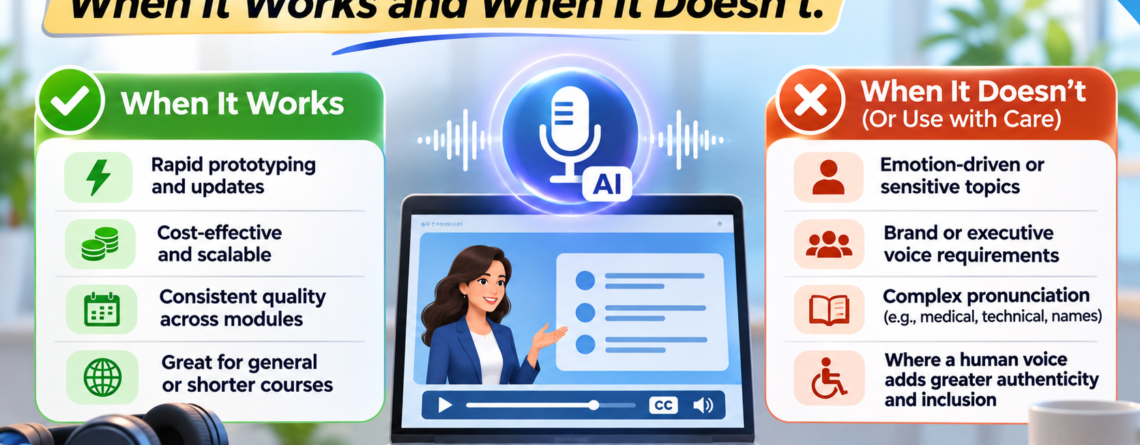
- Content that changes often. If a course updates every quarter, re-recording a human narrator each time is slow and expensive. With AI, you regenerate the affected lines in minutes. For living content, this is a genuine advantage.
- Large volumes of straightforward narration. When you have hours of clear, factual content to voice, AI handles it quickly and consistently, without scheduling a studio or a voice actor.
- Rapid prototyping. Early in a build, you often just need a placeholder voice to test timing and flow. AI voiceover is perfect here. You can hear the course working before committing to final narration.
- Tight budgets and timelines. Not every project can afford professional narration. A good AI voice is far better than no voice, or than forcing a non-native team member to record audio they are not comfortable with.
In all of these, AI voiceover is not a compromise. It is the right tool. The content is informational, the tone is neutral, and consistency matters more than warmth.
Where It Tends to Fall Short
Now the other side, because it is just as important. There are places where AI voiceover, however polished, works against what you are trying to do.
- Emotional or sensitive content. A course on grief, harassment, mental health, or serious safety consequences needs a voice that conveys genuine care. AI can imitate warmth, but learners often sense something is missing, and in sensitive moments that gap undercuts trust.
- Storytelling and scenarios. When a scenario depends on a character feeling real, the subtle timing and emotion of a human performer does heavy lifting. A flat, evenly-paced AI read can drain the life out of a moment that was supposed to land.
- Content where nuance carries meaning. Sarcasm, emphasis, a knowing pause. Human narrators place these instinctively. AI often misses them, and a line delivered with the wrong emphasis can change or flatten its meaning.
- High-prestige, brand-defining courses. Sometimes the course is a flagship, something the organization wants to feel premium. Here the human touch is part of the message. A synthetic voice, even a good one, can signal that corners were cut.
The theme across all of these is the same. When the emotional and human quality of the delivery is part of the learning, AI voiceover struggles, because that quality is exactly what it cannot fully reproduce.
It Is Not Always All or Nothing
One thing worth saying is that you do not have to choose a single approach for an entire course. Some of my best results come from mixing.
You might use AI voiceover for the bulk of the informational content, where speed and consistency matter, and bring in a human voice for the emotional scenario at the heart of the course, where it matters most. The learner gets efficiency where efficiency is fine, and humanity where humanity counts. Thinking in terms of “which parts need what” usually beats a blanket decision either way.
Questions to Ask Before You Decide
When I am deciding for a specific project, a few questions usually settle it:
- What is the emotional weight of this content? The heavier it is, the more a human voice earns its cost.
- How often will this change? The more frequently it updates, the more AI’s flexibility pays off.
- Is the delivery part of the message? If how it sounds matters as much as what it says, lean human. If the voice is just a clear delivery system for facts, AI is fine.
- What does the budget realistically allow? A good AI voice on a real budget beats an imagined human narration that never gets recorded.
None of these have a universal right answer. They just point you to the choice that fits the specific course in front of you.
Match the Voice to the Job
Here is where I land. AI voiceover is a genuinely useful tool that has earned a real place in our work. It is not a cheap imitation to be ashamed of, and it is not a magic replacement for human performance. It is one option among several, and the skill is in knowing which option the moment calls for.
The mistake is treating it as all-or-nothing. People who swear off AI voice entirely are paying more and moving slower than they need to on content that would be perfectly well served by it. People who use it for everything are quietly draining the warmth out of the moments that needed it most.
So the next time you plan a course, do not ask “should I use AI voiceover” as a yes-or-no. Ask where it fits and where it does not, and let the content decide. That is how you get the speed without losing the soul.
If you want a partner who knows when a synthetic voice serves the learning and when only a human one will do, that is exactly the kind of judgment I bring to a project. You can always reach out for help with your next custom eLearning project.