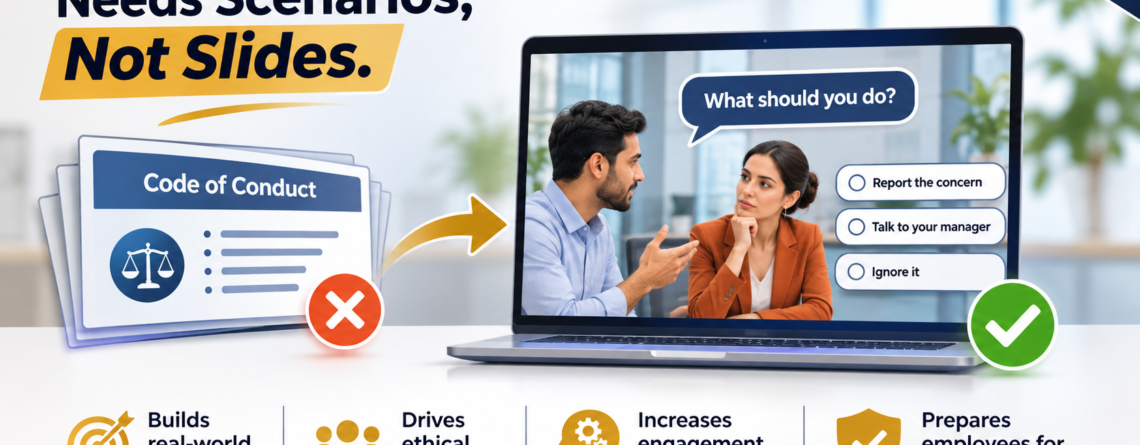
Think about the last code of conduct course you took. If it was like most, it was a tour of policy. A slide on harassment, a slide on conflicts of interest, a slide on gifts and entertainment, each one listing what the rules say, followed by a quiz that mostly asked you to recognize the rule you just read.
Here is the problem with that approach. Nobody has ever faced an ethical dilemma that arrived labeled “this is a conflict of interest, please refer to policy 4.2.” Real situations do not announce themselves. They show up disguised as a favor, a shortcut, a friend asking for a small thing. And a course built entirely of slides never prepares anyone for that.
Code of conduct training, more than almost any other kind, needs scenarios. Let me make the case for why.
The Rules Were Never the Hard Part
Most people already know the rules, at least the broad strokes. They know bribery is wrong. They know you should not harass a colleague. They know stealing from the company is off limits. A slide restating these does not teach them anything they did not already believe.
The hard part was never knowing the rule. The hard part is recognizing the moment the rule applies, especially when that moment is messy, pressured, or dressed up as something harmless.
A vendor offers you tickets to a game. Is that a nice gesture or a gift that crosses a line? A manager asks you to backdate a form “just this once.” Is that helping the team or falsifying a record? These are the moments where conduct actually gets decided, and a slide listing definitions does nothing to help someone navigate them in real time.
Slides Teach Recognition, Scenarios Teach Judgment
This is the core distinction. A slide-and-quiz course can teach someone to recognize a rule. It cannot teach them to exercise judgment, and judgment is the entire skill that code of conduct training is supposed to build.
Here is the difference in practice:
- A slide says what a conflict of interest is.
- A scenario puts the learner in a situation where a conflict is quietly forming, and asks what they would do next.
Only the second one builds the skill you actually care about. When a learner has to read a situation, weigh competing pressures, and make a call, they are practicing the exact mental move they will need when it happens for real. Recognition is passive. Judgment is active. Conduct lives entirely in the active side.
Scenarios Make It Safe to Be Wrong
There is another thing scenarios do that slides cannot. They let people make the wrong choice in a place where it costs nothing.
That is enormously valuable. In a well-built scenario, a learner can take the tempting shortcut, see where it leads, and feel the consequence, all without any real harm. That experience sticks in a way that a warning on a slide never will. We remember the decisions we made and the outcomes we saw far better than the rules we were told.
A good scenario is not about tricking people or catching them out. It is about giving them a rehearsal. When the real moment comes, and it will, they have already been there once. They have felt the pull of the easy answer and practiced choosing the right one. That rehearsal is the whole point, and you simply cannot get it from a bulleted list.
What a Scenario-Based Approach Looks Like
Shifting from slides to scenarios does not mean throwing out structure. It means changing what sits at the center of the course. A few principles I lean on:
- Build around realistic situations. Use the gray areas your people actually encounter, not cartoonish villains doing obviously illegal things. The learning is in the ambiguity.
- Let choices have consequences. When a learner picks the shortcut, show where it leads. Consequence is what turns a choice into a lesson.
- Keep the policy, but make it a resource. The rules still belong in the course. They just work better as something the learner consults to resolve a dilemma than as the thing they passively read first.
- Debrief every decision. After a choice, explain why it mattered and what a strong response looks like. The scenario creates the moment; the debrief turns it into understanding.
None of this is harder to justify than a slide deck. It is just built around the learner doing something instead of watching something.
Train for the Moment, Not the Manual
A code of conduct exists to shape behavior in difficult moments. So the training that supports it should rehearse those moments, not just summarize the manual. When we hand people a stack of slides and a quiz, we are teaching them to pass a course. When we put them inside realistic decisions, we are teaching them to act well when it counts.
That is the shift worth making. Stop asking learners to recognize rules they already know, and start asking them to make the hard calls they will actually face. One builds a completion record. The other builds the judgment your organization is really trying to protect.
So the next time a code of conduct course lands on your desk, resist the pull to march through policy slide by slide. Ask instead what moments your people need to be ready for, and build the course around those.
If you want code of conduct training that puts learners inside real decisions instead of marching them through policy slides, that is exactly the kind of work I love to take on. You can always reach out for help with your next custom eLearning project.