Not long ago, building a course took weeks. Today, you can ask an AI tool to generate a full module in minutes, complete with text, questions, and a tidy structure. It feels a little like magic.
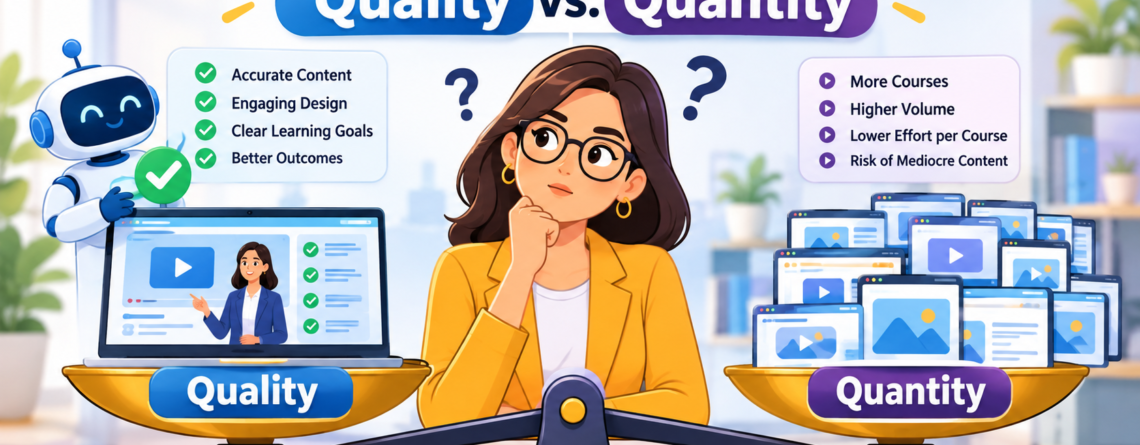
And it raises a question our whole field is quietly wrestling with. If we can now make courses this fast, should we? When speed becomes almost free, the temptation is to make more, and more, and more. But is a flood of quickly generated courses actually good for learning, or are we just confusing output with progress?
I use AI in my work, and I think it is genuinely useful. I also think this is a moment to be clear-eyed. Let me walk through where AI-generated courses help, where they hurt, and how to keep quality from drowning under quantity.
Speed Is Real, and It Is Tempting
Let me give AI its due first, because the benefits are not imaginary. These tools can draft content, suggest structures, generate quiz questions, and knock out a first version far faster than starting from a blank page.
For a developer, that speed is a gift. The blank page is often the hardest part, and having a rough draft to react to can save real time. Used well, AI handles the tedious first pass so you can spend your energy on the thinking that matters.
The danger is not the speed itself. It is what the speed tempts us to do. When making a course becomes this easy, the goal can quietly shift from making good courses to making many courses. That shift is where the trouble starts.
Quantity Is Easy to Measure, and That Is the Trap
Here is why quantity wins so often. It is easy to count. You can point to ten new courses and feel productive. You can fill a catalog quickly and show impressive numbers.
Quality is harder. It does not show up in a count. It shows up later, quietly, in whether learners actually understood and changed how they work. Because it is harder to see, it is easier to neglect, especially when the tools make volume so effortless.
So organizations drift toward the number they can see. More courses, more content, a fuller library. It looks like success. But a library full of mediocre courses is not an achievement. It is just a bigger pile of things nobody learns much from.
What AI Tends to Miss
AI is good at producing content that looks right. What it struggles with is the judgment that makes a course actually teach. Here is where the gaps usually show.
- Real audience understanding. AI does not know your specific learners, their pressures, or the exact confusions they bring to the topic. That knowledge is what shapes a course that truly fits, and it comes from people, not prompts.
- Accuracy you can trust. AI can state things confidently that are subtly or completely wrong. In compliance, safety, or technical training, that is not a small risk. Everything still needs a human and an expert to verify.
- Meaningful practice. AI can generate a quiz, but a quiz is not the same as practice that mirrors the real decisions a learner faces. Designing that takes an understanding of the job AI simply does not have.
- The emotional side of learning. A course that keeps someone engaged, builds their confidence, and makes them feel capable is a crafted experience. AI can assemble the pieces, but the human touch is what makes them land.
None of this means AI is useless. It means AI is a powerful assistant, not a replacement for the judgment that separates a real course from a plausible-looking one.
Use AI to Lift Quality, Not Just Volume
Here is the reframe I keep coming back to. The question is not whether to use AI. It is what you point it at.
If you point AI at quantity, you get a flood of shallow courses. If you point it at quality, something much better happens. You let AI handle the fast, tedious parts, the first drafts and the rough structures, which frees up your time for the human work that actually improves learning. The design thinking, the real practice, the accuracy checks, the polish.
In other words, AI should not be the thing that lets you care less about each course. It should be the thing that gives you more room to care more. Same tool, completely different outcome, depending on what you are chasing.
Keep a Human in Charge of What Matters
Whatever role AI plays in your process, some things need to stay firmly in human hands. These are the checkpoints I never hand off.
A real person should confirm the content is accurate, ideally with a subject matter expert for anything specialized. A real person should make sure the course actually fits the learners and teaches toward a real outcome. And a real person should give it the final review, because AI will not catch the subtle things that make a course feel trustworthy or fall flat.
Think of AI as a capable assistant and yourself as the one responsible for the result. The assistant can do a lot. The responsibility never transfers. That line is what keeps quality intact no matter how fast the tools get.
The Bottom Line
AI has made it possible to produce courses at a speed that would have stunned us a few years ago. That is genuinely exciting, and I am not here to wave anyone away from it.
But speed is a tool, not a goal. The point was never to make the most courses. It was always to help people learn, and a hundred forgettable modules serve that worse than a handful of courses that truly work. Quantity is easy to chase and easy to measure. Quality is still the thing that matters.
So use AI, and use it well. Let it clear the busywork so you can do the human work better. Just do not let the ease of making more quietly replace the harder goal of making it good.
If you want AI used to raise the quality of your courses rather than just the quantity, that is exactly the kind of work I do. Reach out anytime about your next custom eLearning project.